
The Grace of the Arbor is Ember and Blade's permanent progression: a branching tree inside the Sanctuary that starts completely dormant and wakes up node by node as you feed it Amber. It is the only system in the game that survives a run.
Its structure is deliberately open. Nodes strengthen core stats, widen your Blessing pool, or add utility that carries across every future attempt — and with limited Amber you are choosing between specialising down one branch and spreading across several.
The tree
Every node you unlock pays its own reward and reveals the paths behind it. The tree's shape means the cost of a detour is not the Amber you spent, but the depth you did not reach on the branch you actually wanted.
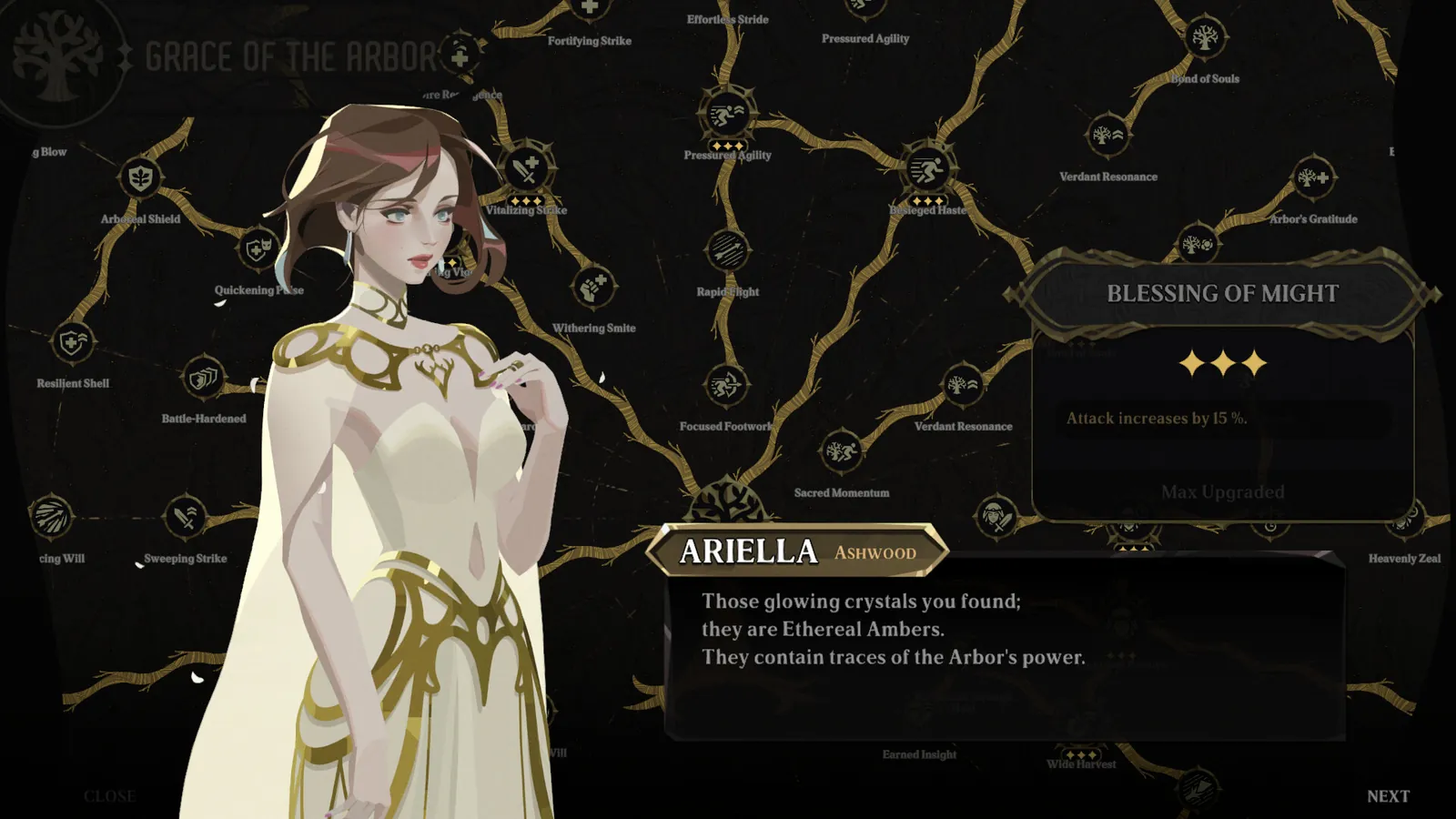 Official media
What the tree can give you, based on what Demo 2.0 documented:
- Core stats — the straightforward nodes.
- Wider Blessing pool — nodes that unlock additional Blessing options rather than raising numbers.
- Stamina ceiling — maximum stamina and recovery speed both live here, which is why they are the first thing worth buying.
- Utility — the long-tail perks that only pay off across many runs.
Demo 2.0 also restructured the tree around the new combat system and replaced the runes it used to provide, so any tree map older than September 2026 is out of date.
The five currencies
Each currency feeds exactly one system. There is no exchange rate, which makes the priority order a matter of knowing what you are short of.
| Currency | How it drops | What it buys |
|---|---|---|
| Amber | Bosses; Arbor purification | Nodes on the Grace of the Arbor |
| Dew | Treasure monsters; Arbor purification | Unlocking and recharging Artifacts |
| Claynite | Bought from a vendor | Relics, crafted at the Workshop |
| Shards | Monsters; breakable props; purification | The Blessing choice on each level-up |
| Blood Crysts | Bosses | Weapon enhancement at the Forge |
Two of them come only from bosses, which is the game telling you that the loop closes on itself: beat a boss to upgrade the tools that let you beat the next one.
Purification
Purifying small Arbor's Reach during a run applies a weapon stat enhancement, and purification is also one of the sources of Amber and Dew. It is the only in-run action that feeds the permanent tree, which makes it the highest-value detour in an act.
Relics and Artifacts
Relics are crafted in the Workshop from Claynite and worn into a run. Three starters are available from the beginning — Hand of the Dead, Birthday Cake and Gladiator — and Burning Heart unlocks once you have met Baphomet for the first time.
Artifacts run on Dew instead: unlocking one costs Dew, and so does recharging it. That makes Dew the currency to hold rather than spend, since an Artifact you cannot recharge is a slot doing nothing.
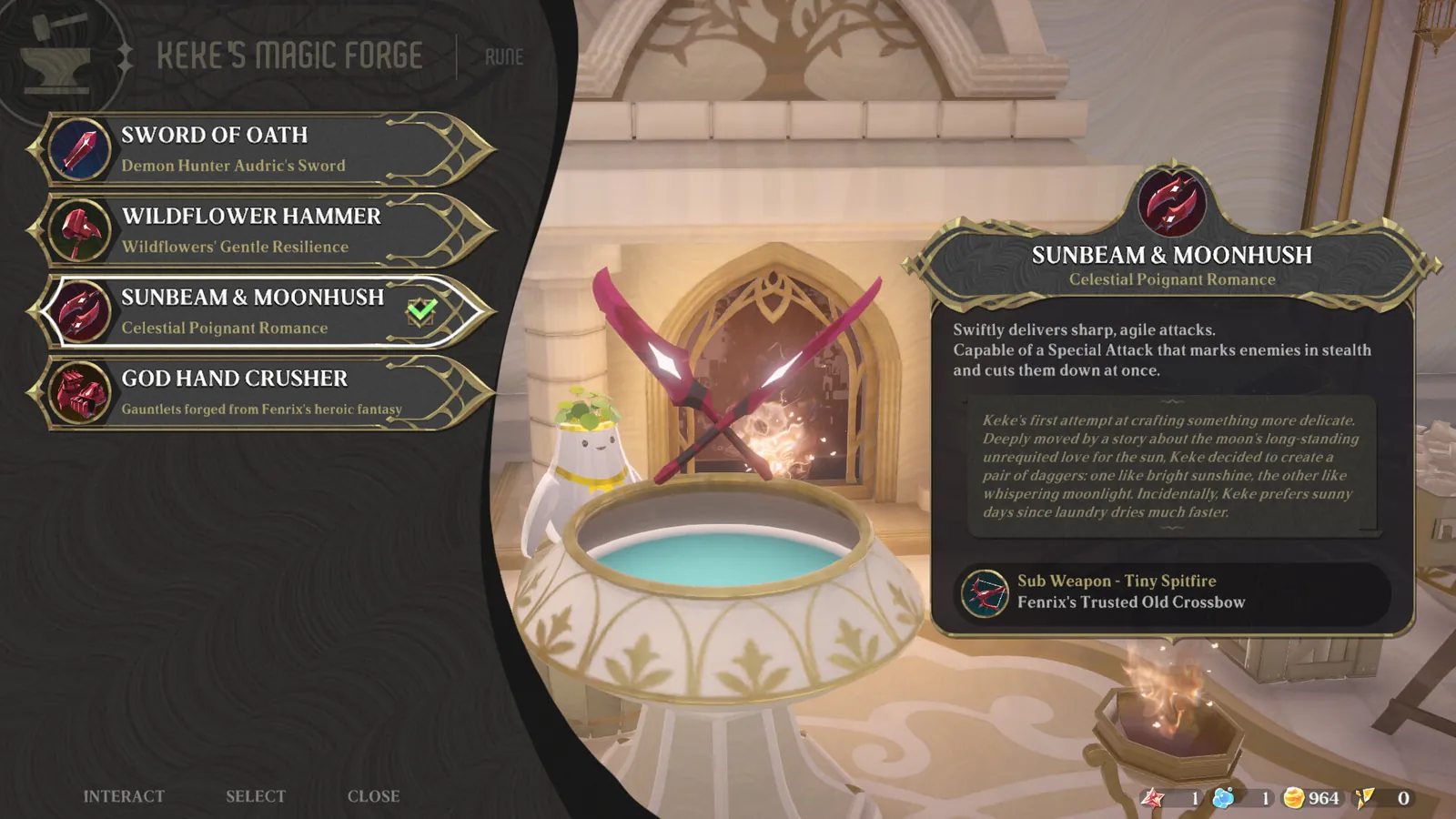 Official media
The Forge
Weapon enhancement happens at the Forge and costs Blood Crysts, which only bosses drop. Since a weapon upgrade improves every future run with that weapon, the Forge is where a stable player converts boss kills into a permanent advantage.
The order that wastes least: get to the Act 1 boss consistently first, then start upgrading. Blood Crysts spent before you can finish a boss are spent on a weapon you are still learning.
What the tree does not buy
It does not buy weapons, relics or Artifacts. Those live in the Forge, the Workshop and the Artifact slots, and each runs on a different currency. A player who pours everything into the tree ends up with better stats and the same gear, which is a fine place to be — just not the place the tree is advertising.
What the tree does buy is permission. Wider Blessing pools mean the level-up screen offers options that were not there before, and stamina nodes mean the combo system is usable rather than theoretical. Those are the purchases that change how a run plays rather than how it scores.
Reading the map before you spend
Nodes reveal outward, so the shape of the tree is a promise about what sits behind a purchase rather than a menu you can browse. That is what makes the first thousand Amber the hardest decision in the game: you are buying a direction, and the useful nodes on the other branches only become visible after someone else has paid for them.
When to purify
Purification is the only in-run action that feeds the permanent tree, and it pays Amber and Dew on top of the weapon enhancement it applies. That makes it the highest-value detour in an act and the one most often skipped by players racing to the boss.
The trade is straightforward: a run that purifies everything arrives at Baphomet slightly weaker than one that ignored it, and every run after it arrives stronger. Since the first clear is the only one that has to happen, purifying on the way is usually the better long-term buy — unless the run is going badly and the boss is the only thing that can rescue it.
The Codex
Demo 2.0 added a Codex that collects action videos, entries on the Break system, and pages for characters and relics. Demo 2.2 added Arcana illustrations to it. It is the only in-game reference for mechanics the tutorial does not explain, and it costs nothing to read.
Amber is not a damage stat
The first nodes that look weak — stamina recovery, maximum stamina — are the ones that let you use the combo system at all. Damage nodes pay off after your inputs are clean, not before.