
Arcana are the second run-scoped system in Ember and Blade, and the easiest one to undersell. They arrive as cards, they stack with Blessings, and their job is to change a rule rather than add a number.
Demo 2.0 added eighteen new Arcana cards and rebalanced the existing ones. That is a large enough swing that Arcana written about before September 2026 should be treated as a different set.
Arcana versus Blessings
The split is clean once you see it:
| Blessings | Arcana | |
|---|---|---|
| Source | Angels | Cards |
| Attach to | A specific action (light, heavy, dash) | Your character as a whole |
| Effect type | Damage, projectiles, fields, set bonuses | Rules: resources, movement, shop behaviour |
| Scaling | Star ranks up to three | Card-specific |
A Blessing makes one of your attacks do something extra. An Arcana changes the conditions you are fighting under — how fast stamina returns, what happens when it runs out, whether the shop restocks.
The stamina cards matter most
The documented Arcana examples are almost all about stamina, and that is not a coincidence: stamina is the constraint the whole combat system is balanced around.
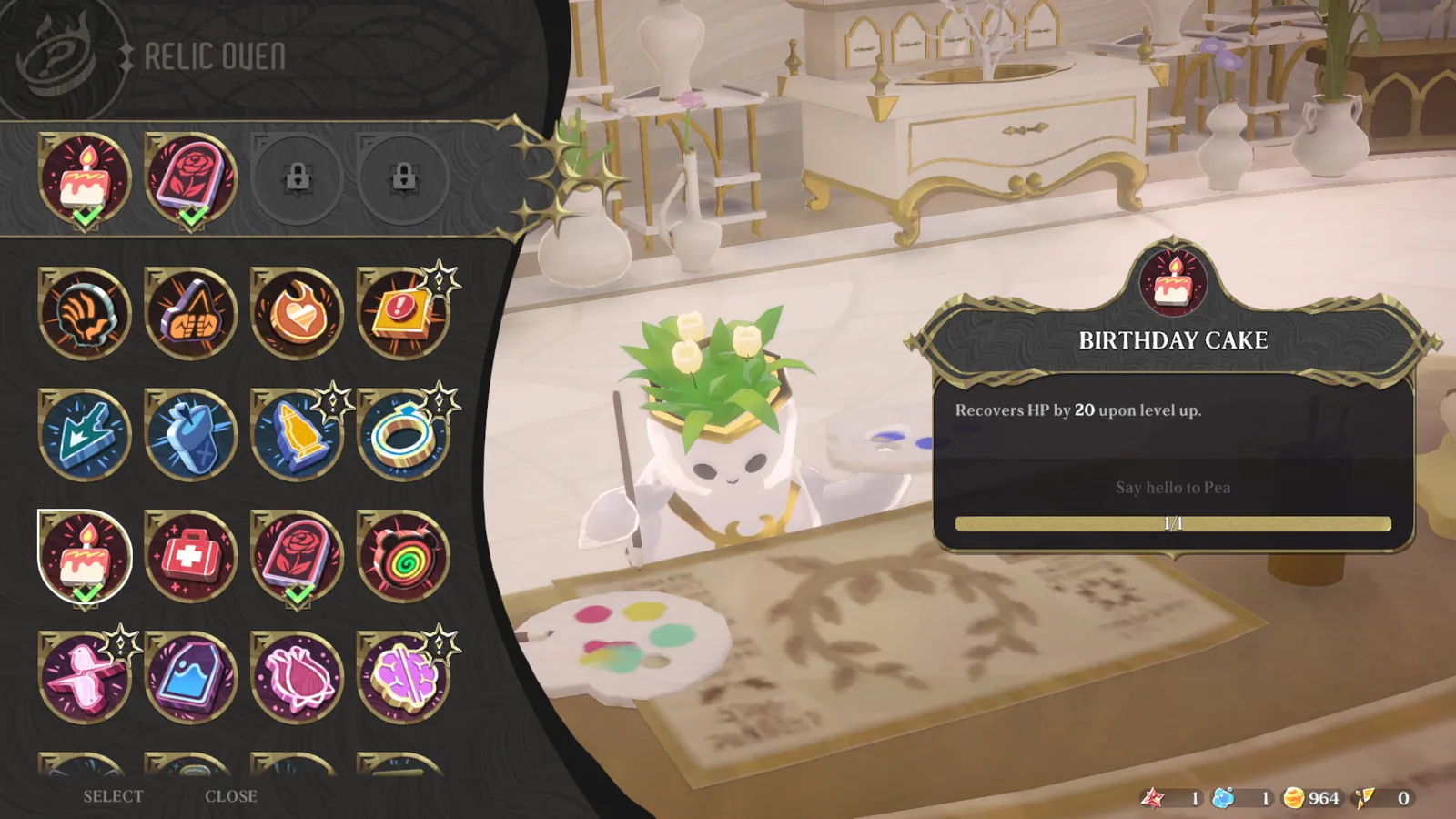
- Refund on hit — some Arcana restore stamina when a dash attack connects, turning the dash from a cost into a loop.
- Reward for empty — others raise attack speed or movement speed while the gauge is empty, which makes the exhausted state a window instead of a punishment.
- Both at once — the pair produces a build that spends stamina deliberately rather than avoiding the spend.
Because maximum stamina and recovery also sit on the Grace of the Arbor tree, the three layers stack. A player with a stamina-focused tree, a refund Arcana and a dash-linked Blessing is playing a visibly different game from someone who took damage nodes.
 Official media
One named card, and what it does
Pile It High, Sell It Cheap governs shop restocking: each shelf restocks once per visit. Demo 2.2 fixed it so that behaviour holds — before that, the card could restock indefinitely, which is the sort of rule-rewrite Arcana are for.
That single example is also the clearest signal of scope: Arcana are not only combat modifiers. Some of them change how the run's economy works.
A stamina build, described
Take one refund card and one empty-gauge card, then put a dash link on a Blessing that hits in an area. The loop becomes: dash in, spend the gauge, hit harder while it is empty, refill on the dash attack that follows.
Nothing in that sequence needs a specific weapon, which is why stamina Arcana are the most portable cards in the game. Swap the Sword for the Shotgun and the loop still works — worse in a crowd, better at keeping distance. That portability is the reason the Grace of the Arbor's stamina nodes pay off in every run rather than in one build.
What Arcana are not
They are not relics. A relic is crafted between runs, slotted before one and kept afterwards; an Arcana is drawn inside a run and disappears with it. A relic is a decision you make once, an Arcana is a decision the run offers you — and when the two point in different directions, the Arcana usually wins, because it is the one you can see.
Cards are also the only system in the game whose text was rewritten wholesale rather than patched — the Arcana added in Demo 2.0 arrived with descriptions written for their actual behaviour, which was not true of Blessings until 2.1.
Reading them in the Codex
Demo 2.2 added illustrations and entries for every Arcana to the Codex, which turns the card pool into something you can study between runs rather than only meet mid-fight.
That matters more than it sounds. Arcana describe rules rather than numbers, and a rule is easier to plan around when you can read it twice. The Codex is also where the Break mechanic and the action videos live, so it doubles as the game's only reference for the systems it does not tutorialise.
Where Arcana progression sits
The February 2026 demo roadmap listed "Arcana Meter progression content" as a Phase 3 item, alongside rune slot progression. The meter itself is not documented in detail, but the direction is: Arcana are meant to have their own progression track inside a run rather than arriving purely as random card picks.
Demo 2.2 gave them illustrations and Codex entries, which is the point at which they became a browsable library rather than a mystery.
How to use them
Three habits, in order of payoff:
- Read every card's rule, not its stat line. The ones that change conditions are worth more than the ones that add percentages, because conditions compound with your build.
- Pick Arcana before Blessings when a level-up offers both. Blessings compete for link slots; Arcana do not compete with anything.
- Do not build around a card you might not draw. Arcana are run-scoped, so a plan that requires one specific card is a plan that fails most runs.
No complete Arcana list exists
Eighteen cards were added in Demo 2.0 and only a handful have been named in official notes. A list claiming all of them today would be inventing card names, so this page describes behaviour and names only the confirmed card.
 Official media